Showing posts with label Macedonian Cuisine. Show all posts

Sunday, February 12, 2012

Kacamak (Cornmeal)

Kacamak, Kachamak, Bakrdan

Ingredients:
  • 400g. Cornmeal
  • 1l. water
  • Salt
  • Oil
Kacamak that is also known as: Kačamak, kachamak or bakrdan is a traditional dish in Serbia, Bulgaria, Albania, Macedonia, Bosnia and Montenegro that is made of cornmeal/cornflour. Instructions for the recipe are very simple:

Put water in a deep bowl, bring to the boil, add salt and gradually add the corn flour, stirring continuously to avoid lumps. The mash should be medium thick.

Cook for half an hour and when cooked pour over with hot fat or oil. You can add potatoes, cheese, hot pepper or kaymak. Serve with yogurt or sour milk


Share/Save/Bookmark

Friday, January 6, 2012

Russian Salad (Ruska Salata)

Russian Salad (Ruska Salata)

Ingredients:
  • 3 potatoes, boiled and chopped
  • 2 carrots, chopped
  • 1 can of green peas
  • 300g. of ham, chopped
  • 300g. mayonnaise
  • 100g. olives, chopped
  • 5 pickled cucumbers, chopped
  • salt to taste

Cook the potatoes and after that cut into slices as same as the carrots, ham, olives and cucumbers. Take all the ingredients (except mayonnaise) in a serving bowl and mix all slowly.

Add salt to taste. You can add pepper too. Now mix it all with mayonnaise. You can garnish with parsley and olives.

Keep in fridge at least for an hour before serving. Try Russian Salad with kiflichki instead of bread. Enjoy


Share/Save/Bookmark

Tuesday, September 20, 2011

Macedonian Skordalia

Ingredents:
  • 2 potatoes
  • 6-7 garlic cloves, minced
  • 1 cup finely chopped walnuts
  • 1/2 cup extra virgin olive oil
  • 1/4 cup red wine vinegar
  • juice of lemon
Combine peeled potatoes, minced garlic, walnuts and salt in a food processor. Puree for some 30 seconds until everything is well blended. Slowly pour in lemon juice, oil and vinegar, alternating between them. Continue pureeing about 3 minutes until mixture is a smooth paste a little looser than mashed potatoes in texture. Enjoy

Share/Save/Bookmark

Sunday, July 10, 2011

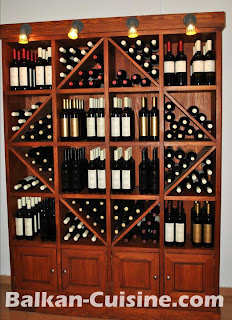
Balkan Wines – Balkan Wineries

Balkan Wines
The beverage that has marked the whole era of humankind is wine. The Romans and Greeks worshiped Dionysus, also known as Bacchus, as the god of wine and merriment. Moreover, wine is important for many religious traditions, such as the Jewish Passover and the Christian Eucharist. It seems that wine has been around us ever since the first men’s footstep. Also, it is believed that wine first appeared in the Balkans around 4500 BC, so here is a small overview of Balkan wineries.

Bulgaria

On one hand, there is Bulgaria which produces wines since the Thracian times. Due to administrative reasons, the vineyards in Bulgaria are classified into five regions, and there are no vineyards only around the capital city, Sofia. One of the wine regions is the Eastern Region, which is affected by the Black Sea climate, and white wine is the most produced wine in this region. Some of the most famous wineries are Varna and Khan Krum. Another region is the Northern Region, and in this area it is produced white and red wine. Well-known wineries from this region are Russe, the Suhindol and Svishtov. Next on this list is the Southern Region which the most familiar for its red wines, and Plovdiv and Assenovgrad are the most eminent wineries. Another wine region is South-Western Region which has the warmest climate of all regions, and red wine is its special. The vineyard that marks this region is Melnik. Finally, the Sub-Balkan Region is the last in this list. This region produses red wine the most, and the recognized winery is Sliven.

Bosnia and Herzegovina

On the second hand, there is Bosnia and Herzegovina with its unique wine taste. The wineries in this country are few, but the wine is one of a kind, and there is no even similar taste no where in the world. The oldest winery in the country is Hepok Vinarija. This winery is founded in 1886 during the Austro-Hungarian Empire. Another winery, which is very exclusive, is Brkic wine family cellar. What makes this winery one-and-only is that there is produced high quality wines, Zilavka and Blatina, which are symbols of the country.


Montenegro

Montenegro, one of the youngest country in Europe is next on our wine list. Only the south part of the country is suitable for wine growing.

The leading “force” in Montenegro is Plantaze, which is the major producer of bottled wine in the former Yugoslavia. It produces Krstac which is wine made of the same called grape only grown in Montenegro and Serbia.


Romania

One of the world’s largest wine makers is Romania, which has same climate as France, the wine country. Romania has four wine regions. One is Tarnave which produces the fruity wines due to the cool climate, and famous wineries in this region are Medias, Tarnaveni, Valea Nirajului, Zagar, Jidvei, Blaj and many more. Another region is Dealu Mare translated as Big Hill. Because it is old in tradition, this region is believed to be the cradle of red wines. The eminent vineyards are Ceptura, Tohani, Urlati, Valea Calugareasca, Tohani, Pietroasa and Breaza. Then, on our list comes Cotnary which produces the sweatiest wines in Romania. Frumusica, Cotnari and Cucuteni are well-known wineries in the region. Finally, Murfatlar is the one of the most important wine regions in Romania. It is placed near the Black Sea which provides needed humidity and freshness in growing grape. Vineyards that mark this region are Medgidia, Cernavoda, and Adamclisi.

Balkan Vineyard

Croatia

Another Balkan country that has perfect wine is Croatia. Its wine has very long history since 5th century BC when the wine was introduced by the Greek settlers, and since then Croatian wine has reaching its peak over and over again. Croatia produces 700 types of wine and has over 300 vineyards which are divided into costal and interior wine regions.

Slovenia

Furthermore, the country that kept the wine heritage is Slovenia which has several wine regions that will last forever. One of them is known as Goriska Brda which produces high quality wine. Another one is the coastal region Kras near the city Koper. Moreover, Podravski or also known as the valley of the Drava River and Posavski or the valley of Sava River are regions that produce unique wine typically only for Slovenia.

Macedonia

Nothing goes without the heart of the Balkan, Macedonia. This country is also placed on our list of Balkan wine countries. Macedonia is sunny, mountainous country whose climate is influenced by the Mediterranean Sea, which makes Macedonian wine only one of its kinds. Furthermore, Macedonian vineries produce all kinds of wine. The dominant role in wine making has Tikves which produces 2/3 of Macedonian wine. This vinery is placed in the centre of the country, and it covers cities Negotino and Kavadarci. Demir Kapija is another town famous for the wine production. Almost all cities in Macedonia have vineries with brilliant wines which taste amazingly.

Serbia

The last one on our list is Serbia. Same like the other Balkan countries, Serbia has an excellent climate for producing wine. Also it has several wine regions which create unique wines. Kinds of grape that are symbols of Serbia are Temjanika and Prokupac.

To conclude, all countries on the Balkan are perfectly wine makers having very old tradition in the production of a quality wine. I could say that wine is embedded deeply in human culture and society especially in the Balkans. Another eminent proof that Balkans is the cradle of wine is the fact that all countries have wine festivals such as Wine Fest in Sarajevo, Tikveski Grozdober in Kavadarci, Vinoskop in Skopje, Vinaria in Plovdiv, Wine Gourmet Festival in Zagreb and many, many more. Your choice is to came, try some wine, try some traditional Balkan dishes and have a wonderful time on the Balkan.


Share/Save/Bookmark

Friday, June 24, 2011

Shopska Salad

Ingredients:
  • 500g. tomatoes
  • 2 cucumbers
  • 1 onion
  • 200g. cheese
  • 1 green hot pepper
  • oil and salt
Wash tomatoes, peel and cut into slices. Peel onion and chop finely. Peel cucumbers too and cut into cubes.

Mix all slowly, pour over with oil, sprinkle with grated or crumbled cheese and with small hot pepper cut into rounds.

This delicious salad is often consumed with rakija or mastika.
Share/Save/Bookmark

Monday, September 20, 2010

Macedonian dinner rolls (Kiflichki)

Ingredients:
  • 3 1/4 cups bread flour
  • 2 tablespoons sugar
  • 1 1/2 teaspoon salt
  • 3 tablespoons butter, at room temperature
  • 1 cup warm water
  • 1 1/2 tsp dry yeast
Mix the yeast in the water. Combine the flour Macedonian dinner rolls (Kiflichki)with sugar and salt, then pour the water and make a dough. Add the butter one tablespoon at a time and knead the dough. Leave to rise in a warm place for an hour. Cut the dough in two and roll each piece as thin as possible. Cut 8 triangles from each piece and make rolls.

Arrange rolls on a baking sheet, brush with eggyolk and sprinkle with sesame seeds, flax seeds, caraway seeds, poppy seeds or salt. Put the baking sheet in a lukewarm oven and leave the rolls to rise again for an hour, then bake them at 170°C, around 15-20 minutes.

Source: Sitnoseckano.blogspot.com

Share/Save/Bookmark

Sunday, August 8, 2010

Sarma

Ingredients:
  • cabbage or grape-vine leaves
  • 1 coffee cup with rice
  • 2 onion pieces
  • 0,5kg. mixed ground meat
  • 250g. steamed meat
  • oil, pepper, salt and spices
Sarma is a traditional meal in the most of the Balkan countries especially for Christmas Eve. It is a heavy dish and usually eaten in the winter days. Here are the directions how to prepare this meal:

Rinse well the leaves, pour over with hot water and drain. Cut the onion into small pieces and fry it on oil. Add ground meat, red pepper, pepper, salt, spices and rice. Then use the mixture to stuff the pickled cabbage or grape-vine leaves. Line them up in a pot, but first line up pickled cabbage at the bottom of the pot.

Put the steamed meat in between the stuffed cabbage leaves. Then, spill over sarma some hot water and boil it on a silent fire and then put them in the oven to bake.

By the end of the baking you can add some oil and red pepper, which have been fried before. Cover the pieces with pickled cabbage leaves. The whole has to be dry, not very moist. You can serve sarma with sour cream or yogurt.


Share/Save/Bookmark

Wednesday, March 3, 2010

Leeks Pie

Ingredients:
  • 1kg. soft flour, type 400
  • 1/2l. warm water
  • a pinch of salt
  • 1-2 tablespoons oil
  • 1 margarine at room temperature
Leeks pie
Put 700 gr of flour in a bowl and mix with the salt, oil and enough warm water to make a dough. transfer to a floured surface and kned, adding water or flour, until it's smooth and soft.
For the dough into a ball, flour its surface, cover with a tea towell and leave for 20 minutes.

Cut the ball in 4 and roll each part with a rolling pin to 1-2 mm thick and spread with 50 g of margarine. With a knife, cut the crust in spiral shape, so you have a long band, 4 cm wide. Take the outer end and coil it into a ball. Flour the surface of the ball, put it on a plate, then in a plastic bag, and in the freezer. Do the same with the other 3 parts.

Warm a little oil and a little margarine and sprinkle the baking sheet. Roll the balls once again, one by one, in rectangular shape, 1-2 mm thick. The first one should be a little bigger than the baking sheet. Put the crust in the baking sheet and sprinkle with the oil and margarine. Roll the second ball and put it over the first, then put the filling. Roll the third crust a litlle bigger than the baking sheet and put it over the filling, creasing it a little. Sprinkle with oil and margarine. Roll the fourt crust, put it over the third, creased, and sprinkle with oil and margarine. Roll the ends of the first crust and sprinkle with oil.

Bake in a preheated oven at 250°C, around 20 minutes, then 5 more minutes at 200°C.

For the leeks filling, fry 8 finelly chopped leeks in oil on low heat, adding a little water and a little milk every few minutes, until the leeks are softened. Add salt and remove from heat. When cooled, add 3 eggs. The filling can be made a day ahead, then mix with the eggs before pouring in the pie.


Share/Save/Bookmark

Sunday, February 28, 2010

Tulumbe

Ingredients:
For the dough:
  • 1/2l. water
  • 2dl. oil
  • 1/2kg. flour
  • 5-6 eggs
  • 1/2 lemon
  • 2 sachets vanilla sugar or 1 vanilla-bean
  • oil for frying
For the syrup:
  • 800g. sugar
  • juice of 1 lemon

TulumbeHeat water and add oil. Bring to the boil, add vanilla and blend in flour, mixing all the time. Simmer until the mixture is smooth, slightly "sticking" to the bottom of the pan. Cool a little, then add eggs one by one. After adding each egg, work well and leave to stand for a while every time.

When ready, put the dough into the confectioner's pipe with a broader star-like nozzle. Heat oil. When hot enough, press out pieces of dough about 5-7cm long. Fry on all sides until nicely brown.

Cook sugar, water and lemon juice for 10-15 minutes and then cool. Pour cooled syrup over warm cakes. Serve cold.

Photo: Wikipedia

Share/Save/Bookmark

Tuesday, November 3, 2009

Macedonian pacha

Ingredients:
  • 1-1.5kg. pork legs, ears and head
  • black peppercorns
  • parsnip, sliced
  • carrots, sliced
  • 1 onion
  • 1 bay leaf
  • 1/2 lemon
  • 1 garlic bulb
Put the meat in a large, deep pot with cold water and cook it. When there is no foam add the bay leaf, black peppercorns, parsnip, carrot, onion and lemon juice. Cook for 4-5 hours. Much of the water evaporates. Take it out from the heat and leave it to cook. Remove the fat from the surface, strain the soup with a strainer, remove the bones from the meat and arrange the meat in a separate dish.

Cut the carrots and parsnip in slices and put them in the same dish. You may place slices of hard boiled eggs in the dish. Add also the crushed garlic with salt. Finally pour the soup over the meat and the vegetables and leave in a cool place until it turns to a jelly.

Share/Save/Bookmark

Sunday, October 4, 2009

Ajvar

Ingredients:
  • 4 aubergines
  • 8-12 fresh red paprika
  • chili peppers to taste
  • 1-2 dl. oil
  • 1 onion, minced
  • 2 garlic cloves, chopped
  • 1 tablespoon lemon juice (or 1 tablespoon red wine vinegar)
  • salt and pepper to taste
AjvarAjvar is a popular appetizer made of roasted paprika, ripe tomatoes, and even string beans can be combined into ajvar. Ajvar is a seasonal dish in Macedonia, Serbia and other former parts of Yugoslavia, always made in late summer and early autumn, just after the paprika harvest, when many households bottle their own ajvar for use throughout the winter season. Here are the directions:

Wash aubergines, drain, put into the heated oven (175-200°C) and bake then peel while still warm. Wash paprika's, wipe and dry fry on top the stove, then put into deeper dish, sprinkle with cold water, cover and leave to cool. Skin cooled paprika's and remove seed. Grind paprika's and aubergines together. Peel onion, chop finely, cook slowly in heated oil until quite soft. Towards the end add cleaned and crushed garlic, cook shortly together, set aside, add ground paprika's and aubergines and mix (very often ajvar is prepared without adding onion and garlic).

Turn all into a deeper dish and drip in oil slowly, stirring all the time. When all the oil is used, add lemon juice or vinegar, salt, pepper and mix well. Put into a bowl, shape nicely, sprinkle with more pepper if desired and pour over with some more oil.

Serve as an appetizer to spread on thick slices of country-style white bread or flat pita bread with chunks of feta cheese, or use as a side dish to accompany grilled or roasted meats.

Ajvar is put into small clean jars pressed tightly so that there are no bubbles in them and the jars covered with cellophane ot parchment.

Worth reading:


Share/Save/Bookmark

Thursday, July 30, 2009

Kjebapchinja, Macedonian style

Ingredients:
  • 800g. ground young beef
  • 200g. ground mutton
  • 100g. onion
  • 20g. oil
  • 5 cloves of garlic
  • salt and pepper
  • oil for brushing
Mix meat, kneed thoroughly and leave in a cool place to sit for several hours. Chop onion finely, heat oil, add onion and cook slowly until it is soft and beginning to color. Peel garlic and chop finely. Add onion and garlic to meat, season with salt and pepper. Work all into a meat mixture, leave for a short while in a cool place, then shape into smaller kjebapcinja.

Grill at first on very hot grill. Brush with oil while grilling.Serve with spring onions, tomatoes and small hot peppers.


Related recipes:

Share/Save/Bookmark

Saturday, July 4, 2009

Macedonian pogacha (Rich bread)

Ingredients:
  • 750g.-1kg. flour
  • salt
  • 2 tablespoons lukewarm milk or water
  • 20 g. fresh yeast
  • 1 teaspoon sugar
  • 1/2 dl. oil
  • lukewarm water as needed
  • 2-3 eggs
  • salt
  • lard or oil for greasing
  • flour for dusting
Macedonian pogacha (Rich bread)Pogacha (Rich bread) is something like white bread and there are as many recipes for it as there are shapes. The next recipe is from Macedonia:

Sift flour. Crumble yeast, add some sugar, some flour and lukewarm water or milk. Mix well until smooth and leave to stand in a warm place to rise.

Make a well in the center of flour, add oil, egg yolks and one whole egg, salt and creamed yeast. Pour in some lukewarm water and mix all. Knead into smooth dough until bubbles appear in it. Dust the dough with some flour and leave it to stand in a warm place for about 45 minutes.

Grease a baking pan (tepsiya) with oil or lard. Toss the risen dough onto a board dredged with flour, knead it shortly, put into the tepsiya, cover and leave to stand like that for about 10-15 minutes. Before baking, prick with a fork in several places. Bake in the oven preheated to 200 Celsius degrees for about 30-35 minutes. When the crust is brown, it can be covered with tin paper or thin foil. When done, sprinkle the pogatcha with some water and wrap it up with clean cloth.

Serve warm, preferably with kaymak, some cheese spread or the like, as an appetizer.

The recipe is adapted from "The Balkan Cookbook" by Radojko Mrljesh

Share/Save/Bookmark

Saturday, June 27, 2009

Stuffed peppers

Ingredients:
  • 10-15 bigger paprikas/peppers
  • 1-1.5dl. oil
  • 2 onions
  • 150g. rice
  • 700g. mixed ground meat
  • salt and pepper
  • ground hot paprika
  • tomato
  • lukewarm water
Photo of stuffed peppersStuffed peppers, Punjena paprika (Serbia, Bosnia and Montenegro), Polneti piperki (Macedonia), Pulnena paprika/Pulneni chushki (Bulgaria) or Ardei umpluti (Romania) is a famous Balkan dish consisting of paprikas/peppers filled with mixture of meat and rice. There are many variations of stuffed peppers across Balkan countries but here we present you the basic recipe that can you modify by taste:

Slice the tops off the peppers. Pull out the seeds and the cores. Dip them in warm water and leave to get soft.

Heat oil, add finely chopped onion, cook it slowly until sloghtly brown. Pick over rice, wash and cook in salted water, rise, drain and add to soft onion, then stirr in meat. Cook slowly together, add salt, pepper and ground paprika. Cool a little.

Place the pepper shells in a baking dish that will hold them snugly together. Spoon the filling into the peppers. Replace the tops with peace of tomato. Pour 3 tablespoons of water around the peppers and bake for about 30 minutes in the oven preheated to 175°C until filling is puffed and the peppers are soft. Serve warm or cold.


Share/Save/Bookmark

Sunday, June 14, 2009

Overview of Macedonian Cuisine

Macedonia has a long and praised tradition of culinary delights. Macedonian Cuisine has been affected by the nations from the Mediterranean space and also by the countries from the Balkans. The strongest influence come from Turkey because of the long centuries of Ottoman rule and some of the dishes that have Turkish origin are: beef kebabs, kadaif, burek... and there is also well known Turkish coffee.

The meat has a very important role in the Macedonian food. People use for the recipes many types of meats that range from pork, beef, lamb and chicken. The freshwater fish, the Lake Ohrid Trout, particularly, is enjoyed by the Macedonian and the game does not make an exception. The Macedonians also produce white and red wines produced by high quality grapes (Vranec, Merlot, Cabernet Sauvignon...) that are recognized world wide for their specific taste. Other beverages that are worth to be mentioned are rakija and mastika. The beer is also popular and it is appreciated both by the locals and the tourists.

The Macedonian cuisine does not imply knowing any special cooking techniques. People use the same preparation methods as the rest of Europians. Of course, each dish requires being preparated in a certain way. Macedonian food is characterized by using fresh ingredients of good quality, proper use of herbs and spices, the famous olive oil, and its basic simplicity. The taste of vegetables and fruits is recognizible because of the good climate conditions.

One of the unique and specifical preparation method of Macedonian cuisine is slow homemade cooking in covered ceramics and pottery, over fire resulting with meals combined with stuffed vegetables and wraps. A rich variety of meat dishes, grills, fried meats, kebaps, stews, meat cooked in a crock or pan, and Olive oil dishes what includes fry eggplants, peppers and zucchini or cook in an onion and tomato sauce and letting them simmer, will welcome you to taste Macedonian food.

Some of the traditional Macedonian foods:


Share/Save/Bookmark

Thursday, May 28, 2009

Macedonian bread

Ingredients:
  • 1 tablespoon active dry yeast
  • 3 1/2 cups flour
  • 1 1/4 cups warm water
  • 2 tablespoons olive oil
  • 1 teaspoon salt
  • 1/4 teaspoon sugar
When we write about Macedonian food, the bread is infallibe part of daily meals. Today we'll present you a one of many recipes of traditional Macedonian bread:
In a mixing bowl, combine yeast with 1 1/2 cups of flour. Combine water, oil, salt and sugar and add to yeast mixture. Beat fro 1/2 minute with an electric mixer at low speed and then beat for 3 minutes at high speed.
Work in remaining flour by hand to form smooth and elastic dough. Put in a greased bowl in a warm spot, cover and let rise for 45 minutes. Punch dough down, divide into 12 pieces and roll each into a ball. Let rest for 10 minutes.
Flatten each ball into a 5-inch circle. Place on greased baking sheet, cover and let rest for 20-30 minutes. Preheat oven to 200°C. Bake for 9-10 minutes until puffed and lightly browned on bottom. Immediately wrap in a foil and cool.

Share/Save/Bookmark

Monday, May 11, 2009

Gravche Tavche

Ingredients:
  • 500g. white beans
  • 1 onion
  • 1 red paprika
  • 100ml. cooking oil
  • 2-3 pieces of red dry capsicum
  • pepper, salt, plain flour, parsley and mint
Gravche-Tavche (Gravce Tavce) is a traditional Macedonian food that is prepared almost every week in every family. Here is preparation method:

Wash the beans and leave them to stay in water over night. After that, cook them until it starts boiling, drain the beans and put them in another pot of hot water. Then add 1/2 chopped onion and capsicum. Continue to cook it until the beans are soft but integral. If there is too much water left, drain the beans.

Fry the chopped onion (the other 1/2) and paprika with one spoon of plain flour in cooking oil and then add this to the beans. Put everything in a pottery saucepan and then pour some parsley, mint, pepper and salt on it. Put the saucepan in the oven and bake for a while. The beans should not be too dry. Serve warm.

Share/Save/Bookmark

Wednesday, April 29, 2009

Vanilici

Ingredients:
  • 500g. pork fat
  • 8tbsp. sugar
  • lemon
  • 2 eggs
  • 2 egg yokes
  • 1kg. flour
  • powdered sugar
Beat well the pork fat and the sugar. Add the lemon juice, 2 eggs and 2 egg yokes, mix with the flour and make a dough. Spread the dough in one 1,5cm thick layer and make molds with a small glass. Stick two by two with marmalade between and bake at 200°C. When baked toss each cookie in powdered sugar. These cookies are very often prepared in Macedonia for Christmas and Easter.

Vanilici without powdered sugarVanilici with powdered sugar
Share/Save/Bookmark

Thursday, April 16, 2009

Kjoftinja (Meatballs)

Ingredients:
  • 1 pound ground beef
  • 1/2 cup grated onion
  • 1 tablespoon minced garlic
  • salt and pepper to taste
  • 1/4 teaspoon dried oregano
  • 1/8 teaspoon dired mint
  • 1 or 2 slices white bread
  • 1/2 cup white wine or water
  • 1 egg
  • flour for rolling
  • vegetable oil for frying
Kjoftinja is a frequently consumed recipes of Macedonia. It basically a dish of meatballs, which is considered to be one of the most popular Macedonian cuisines. A series of ingredients are required to prepare this mouth-watering dish. However, as all these ingredients are easily available, anyone can try it out at home.
First mix onion, garlic, mint, pepper, oregano and meat. Add salt according to the taste. Thereafter the slices of the bread are moistened into water or wine. The meat is then added to the softened bread and egg. Knead the mixture thoroughly and shape it into balls. Thereafter fry these balls in vegetable oil. Fry the balls until they get brown. It is now ready to serve. It is always advisable to serve the preparation hot. Kjoftinja is very tasty and as it takes less time for preparation, most of the Macedonians prefer to have it.
Source: Mapsofworld.com (Directions)

Share/Save/Bookmark

Friday, April 10, 2009

Tarator

Ingredients:
  • 1/2kg. cucumbers, finely chopped
  • 2,5dl. sour milk
  • 3 garlic cloves, finely chopped
  • 1 hot pepper
  • salt
  • parsley
Tarator or Taratur is one of the most popular macedonian salads, but also well known in the whole Balkan. You can prepare it in the following way:

Peel the cucumbers, cut into small cubes, salt and leave for ten minutes. Drain the cucumbers, add the sour milk or sour cream, garlic and hot pepper, season with salt and mix well. Sprinkle with chopped parsley, cool and serve.

Share/Save/Bookmark
Related Posts with Thumbnails
 
Template by: Abdul Munir